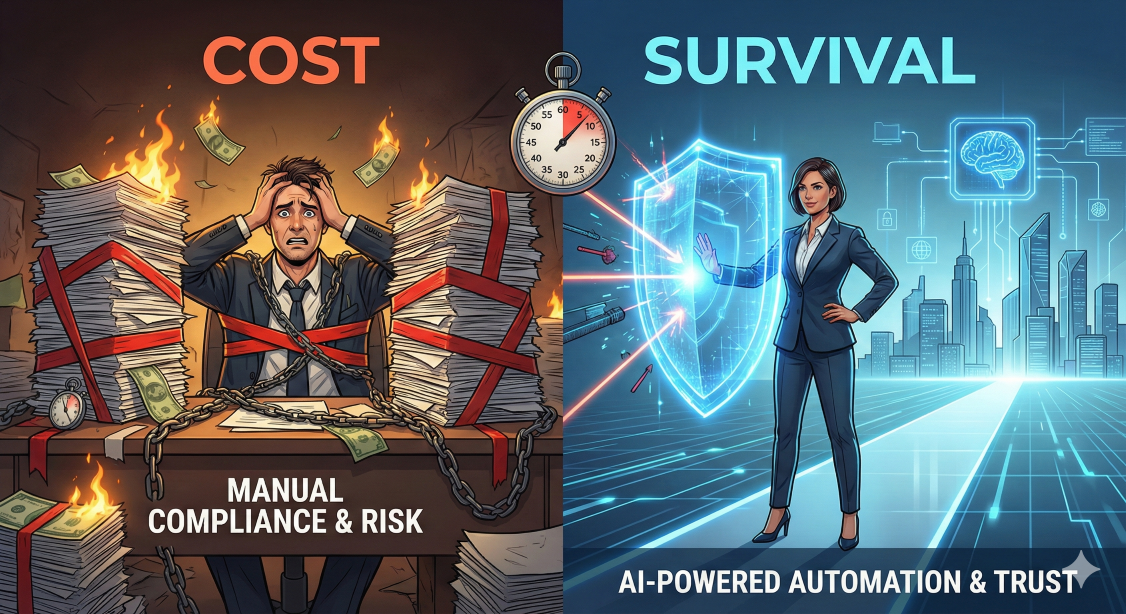

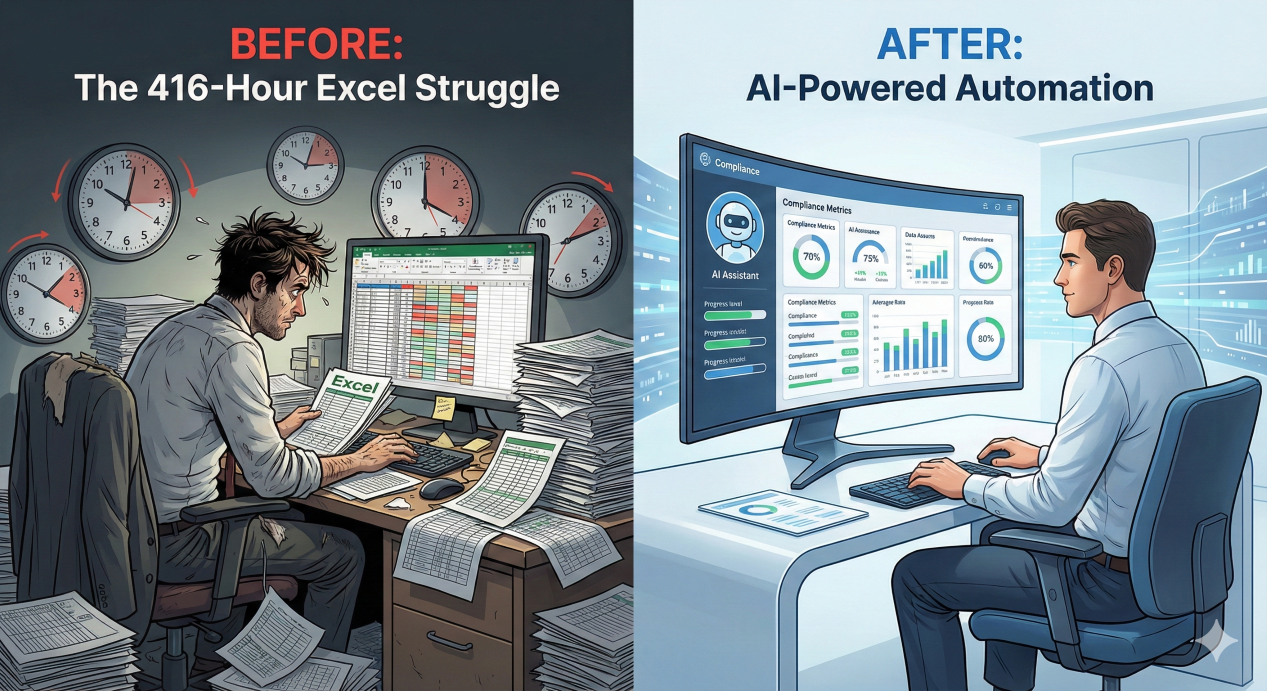
Are you still working overtime as if it were a daily routine as the security certification audit season approaches? The sight of managers sighing while rummaging through folders containing supporting documents, with Excel files listing hundreds of control items open, is the sad self-portrait of the corporate compliance field in South Korea.
The reality of spending 52 days (416 hours) a year solely on ‘document work’
There are surprising statistics. In order for corporate security/compliance managers to respond to certification audits such as ISMS-P or ISO 27001 Annual average of 416 hoursIt means to inject.
If calculated based on an 8-hour workday, it is a whopping 52 daysIt amounts to wasting nearly two months of the year on ‘simple, repetitive administrative tasks’ such as filling in Excel cells and organizing supporting screenshots to meet certification standards, rather than on strategic work that actually enhances the company’s security level.
Why does it take so much time?
- Endless Tag: “Please send me the server access logs,” “Where is the list of attendees for last month’s security training?” The person in charge spends the entire day scouring internal messengers and emails, repeating a game of ‘data hide-and-seek’ as they request and gather materials from other departments.
- Complex Mapping Tasks: Collected data must be individually cross-referenced and linked to determine which of the hundreds of certification criteria it corresponds to. This process relies solely on the person in charge’s ‘intuition’ and ‘experience,’ and the quagmire of Excel only deepens.
A risk too big for ‘the person in charge alone’ to handle
A bigger problem is that one or two people are in charge of this entire process. This poses a serious potential risk to the company.
- The Normalization of Human Error: When humans handle thousands of data records manually, omissions or errors are inevitable. This can result in point deductions during reviews or lead to actual security gaps.
- Work paralysis if person in charge leaves: Certification know-how exists only in a specific individual’s mind and in an Excel file on their personal computer. What if that person leaves the company? The company’s compliance response system collapses in an instant, and everything must start over from scratch.
- Burnout and Decreased Job Satisfaction: For those in charge who want to leverage their expertise to establish the company’s security strategy, endless ‘Excel wrestling’ causes severe burnout.
Now it is time to let go of ‘Excel’ and welcome ‘AI colleagues’.
We cannot keep valuable talents locked up in Excel prisons forever. Fortunately, technology has advanced, and now, even in compliance work… AI-based automation The wind is blowing.
Introducing the latest technology, such as the solution (Klarisk) presented in the plan, dramatically changes the work environment.
- Don’t look for it, AI brings it: AI integrates with internal systems (Jira, Slack, Google Drive, etc.) to automatically identify and collect necessary supporting documents. The time spent on ‘data collection,’ which accounted for the majority of the 416 hours, is drastically reduced.
- Smart mapping that understands context: It is not simple keyword matching. AI understands the meaning of the regulation and the content of the collected document (Semantic Understanding) and automatically connects it by stating, “This document is proof for item A.12.3.1 of ISO 27001.”
- Transition to a Continuous Monitoring System: Instead of a ‘homework’ done all at once once a year, an ‘ongoing management system’ becomes possible where AI checks a company’s compliance status and identifies vulnerabilities 24 hours a day, 365 days a year.
conclusion
416 hours per year. If we free this time from simple, repetitive tasks and return it to the responsible personnel, how much higher could our company’s security level be?
It is time to stop “wrestling with Excel” and start a smarter compliance response. This is the surest investment to protect personnel and, furthermore, reduce corporate risk.